Competition

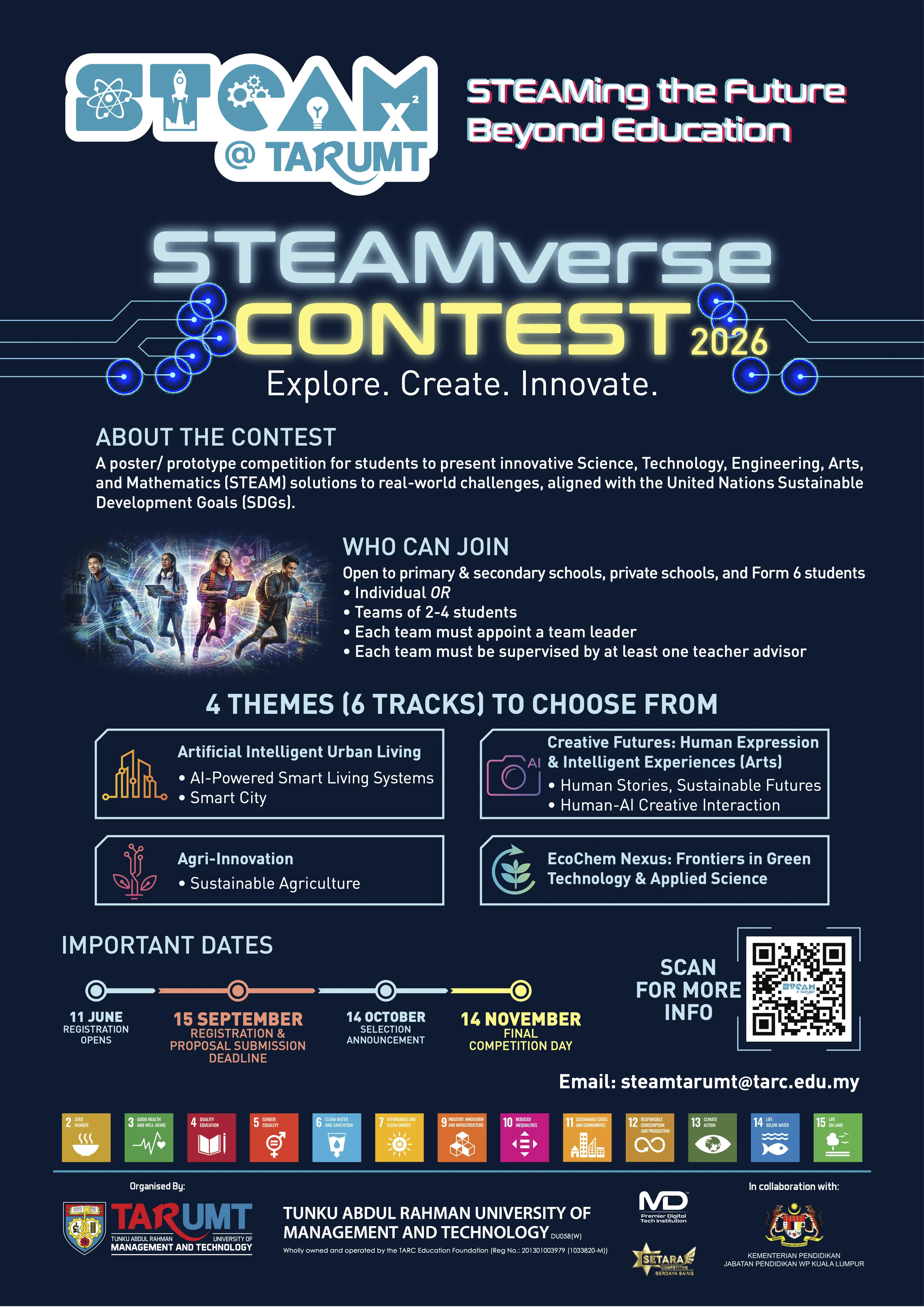
STEAMverse Contest 2026

Explore. Create. Innovate.

A poster and/or prototype competition where students present innovative Science, Technology, Engineering, Arts, and Mathematics solutions to real-world challenges aligned with the United Nations Sustainable Development Goals.

Opens

11 June 2026

Deadline

15 September 2026

Selection

14 October 2026

Final Day

14 November 2026

STEAMverse Contest 2026 poster
About

Innovation with purpose

STEAMverse Contest 2026 inspires students to explore STEAM through creativity, experimentation, problem-solving, interdisciplinary thinking, and effective communication. Participants may develop prototypes, models, systems, or creative works depending on their selected track.

Who can join

  • Primary schools
  • Secondary schools
  • Private schools
  • Form 6 students

Team format

  • Individual or team participation
  • Teams of 2-4 students
  • One appointed team leader
  • At least one teacher advisor

Interest

Cultivate interest in STEAM among primary and secondary school students.

Thinking

Encourage critical thinking, creativity, and problem-solving across domains.

Teamwork

Develop innovation, teamwork, and communication skills.

Integration

Combine technical knowledge, artistic expression, and human-centered thinking.

Impact

Apply ideas to real-world challenges with meaningful sustainability goals.

Themes and Tracks

Choose one competition track

Each team selects one track only. Prototype tracks require a prototype with poster; Creative Futures tracks use poster presentation.

Theme 1

Artificial Intelligent Urban Living

AI-Powered Smart Living Systems

Primary and secondary students · Prototype with poster

AI applications in smart home environments for comfort, safety, energy efficiency, quality of life, automation, security, energy management, and assistive technologies.

Smart City

Primary and secondary students · Prototype with poster

AI-based solutions for mobility, public safety, infrastructure management, environmental monitoring, and urban sustainability. Smart home projects are not included in this track.

Theme 2

Agri-Innovation

Sustainable Agriculture

Primary and secondary students · Prototype with poster

Plant cultivation and farming innovations for productivity, sustainability, food security, smart farming, precision agriculture, crop management, irrigation, and environmentally friendly methods.

Theme 3

Creative Futures

Human Expression and Intelligent Experiences · Poster presentation

Human Stories, Sustainable Futures

Secondary students only

Human-centered storytelling and creative expression highlighting social, cultural, and sustainability-related issues.

Human-AI Creative Interaction

Primary and secondary students

Digital media, generative art, interactive systems, or immersive designs showing how humans and AI collaborate creatively through a professionally designed infographic poster.

Theme 4

EcoChem Nexus

Frontiers in Green Technology and Applied Science · Secondary students only · Prototype with poster

Interdisciplinary green solutions across sustainable living, smart city solutions without AI, future technology, renewable energy, and waste-to-wealth innovation. Smart city projects under this track must not include any AI element.

Requirements

Submission and proposal checklist

Prototype or model

  • Working model or functional concept
  • Clear concept aligned with the selected track
  • Relevant to at least one listed SDG
  • Safe, stable, suitable for display and demonstration
  • Physical model, device, engineering system, or simulation where hardware is not feasible

Poster

  • Project title and team details
  • Problem statement, objectives, methodology, results, and visuals
  • SDG relevance, conclusion, impact, and future improvements
  • Recommended poster size: A1
  • Prototype tracks must present poster and prototype together

Proposal submission

  • Limited to 1 page
  • 150-200 words
  • Include project title, team details, name, and school affiliation
  • Include problem statement, proposed solution, how it works, and expected benefits
  • Visuals are encouraged
Open proposal template
SDG Alignment

Align every idea with sustainability

Projects should align with at least one listed United Nations Sustainable Development Goal.

SDG 2: Zero Hunger

SDG 3: Good Health and Well-being

SDG 4: Quality Education

SDG 5: Gender Equality

SDG 6: Clean Water and Sanitation

SDG 7: Affordable and Clean Energy

SDG 9: Industry, Innovation and Infrastructure

SDG 10: Reduced Inequalities

SDG 11: Sustainable Cities and Communities

SDG 12: Responsible Consumption and Production

SDG 13: Climate Action

SDG 14: Life Below Water

SDG 15: Life on Land

Structure

From registration to final presentation

01

Registration

Online registration includes team details, school name, and project title.

02

Proposal

Teams submit a short project proposal or abstract for review.

03

Development

Teams develop their innovation, prototype, model, system, or poster according to the selected track.

04

Final day

Booth setup, poster display, live demonstration where applicable, and question and answer session with judges.

Rules

Rules and regulations

Open each section to review originality, safety, submission, presentation, conduct, and teacher advisor responsibilities.

Submission requirements
  • Prototype-based tracks require a prototype or model and a poster presentation.
  • Creative Futures tracks require a poster presentation.
  • Prototype and poster must be directly related for prototype-based tracks.
  • Submissions with only a poster or only a prototype will not be accepted for prototype-based tracks.
Proposal submission
  • Proposal is limited to 1 page and 150-200 words.
  • Include project title, team details, school affiliation, problem statement, proposed solution, how it works, and expected benefits.
  • Visuals such as graphs, diagrams, or images are encouraged.
Competition structure
  • Online registration collects team details, school name, and project title.
  • Teams submit a short proposal or abstract for review.
  • Teams develop their innovation, prototype, model, system, or poster according to the selected track.
  • Final presentation day may include booth setup, poster display, live demonstration, and judge question and answer session.
General rules
  • Projects must be original and student-led.
  • Plagiarism or copied designs will result in disqualification.
  • Projects must be completed before the competition day.
  • Teacher advisors may guide students but must not complete the project.
Project guidelines
  • Projects must be related to STEAM fields.
  • Projects should solve a real-world problem.
  • Projects must be safe and suitable for a school environment.
  • Use of recycled or low-cost materials is encouraged where suitable for the track.
Safety rules
  • Dangerous materials are not allowed, including toxic chemicals, explosive materials, flammable materials or chemicals, open flames, live animals, hazardous equipment, or any item deemed unsafe by the organizers.
  • Electrical components must be low voltage and safe.
  • All projects must comply with safety regulations.
  • Teacher supervision is required during prototype development.
Submission and prototype rules
  • Only one project is allowed per team.
  • All submissions must meet the stated deadlines.
  • Late or incomplete submissions will not be accepted.
  • Prototypes must be student-built, portable, functional, demonstrable, and manageable within the allocated booth or display area.
  • Improvements to existing ideas must show clear innovation or added value where applicable.
  • Eco-friendly, recyclable, or biodegradable materials are encouraged.
Presentation and conduct rules
  • Each team is allocated 10-15 minutes for presentation and 5 minutes for questions and answers.
  • All team members must participate during the presentation.
  • Participants must behave respectfully and professionally.
  • Disruptive behavior or misconduct may lead to disqualification.
  • Participants must follow the event schedule strictly.
Teacher advisor responsibilities
  • Guide and supervise students.
  • Ensure safety compliance.
  • Encourage independent student work.
  • Verify the authenticity of the project.
Judging criteria and awards
  • Innovation and Creativity: 25%
  • Scientific or Technical Understanding: 25%
  • Practical Application and Feasibility: 20%
  • Sustainability Impact (SDGs): 15%
  • Presentation and Communication: 15%
  • Awards include Gold, Silver, Bronze, Best Innovation, Best Presentation, consolation awards, certificates, trophies, or medals.
Registration

STEAMverse registration form

Registration and proposal submission deadline: 15 September 2026. The submit button is currently held on-page while the backend endpoint is prepared.

School details
Group details
Teacher advisor
Student 1 / Team Leader
Student 2
Student 3
Student 4
Track selection
Proposal file

Upload a 1-page, 150-200 word project proposal. Use the proposal template and include team details, school affiliation, problem statement, proposed solution, how it works, and expected benefits.

Judging

Judging criteria

Innovation and Creativity25%
Scientific or Technical Understanding25%
Practical Application and Feasibility20%
Sustainability Impact (SDGs)15%
Presentation and Communication15%
Awards

Recognition for participants

  • Gold, Silver, and Bronze awards
  • Best Innovation Award
  • Best Presentation Award
  • Consolation Awards
  • Certificates for all participants
  • Trophies or medals for winners
Important Dates

Contest timeline

11 June 2026

Pre-registration opens

15 September 2026

Registration and proposal submission deadline

14 October 2026

Selection announcement

14 November 2026

Final competition day

Contact

Questions?

Organized by Tunku Abdul Rahman University of Management and Technology (TAR UMT), in collaboration with Jabatan Pendidikan Wilayah Persekutuan Kuala Lumpur.

[email protected]